How to Choose a Digital Signage Provider in Australia
As the world of technology grows, so too does the number of businesses taking advantage of it to get themselves ahead. It comes as no surprise that the market for digital signage in Australia is more active than ever – but also more crowded. From boutique local installers to global SaaS platforms, the range of options available to Australian businesses can make the selection process genuinely overwhelming.
So where do you start?
Get it right, and you have a scalable communications tool that grows with your business and delivers measurable returns. Get it wrong, and you are locked into a system that cannot keep up, costs more than expected, or leaves you without support when something goes wrong.
If you’re ready to dive into the world of digital signage, then we’re here to help. Use this guide to discover exactly what to look for when choosing a digital signage provider in Australia, so you can decide with confidence.
1. Start with Your Business Requirements, Not the Product Demo
Before you compare vendors, it’s important to be clear on what you actually need. Digital signage aims to support your business, and that support will look different for every business. For example, the right digital signage company for a single-location café is very different from the right provider for a national retail chain with 80 screens across 20 sites.
Ask yourself:
- How many screens do you need now, and how many might you need in two or three years?
- Will your screens be indoors, outdoors, or both?
- Do you need to manage content remotely across multiple locations?
- What types of content will you display: static images, video, live data feeds, social media?
- Do you have an internal IT team, or do you need a platform your non-technical staff can manage?
By answering these questions first, you can filter your vendor shortlist against real requirements rather than being swayed by features you will never use. Plus, it will save you plenty of time in the process.
2. Cloud-Based Platform vs Local Server: Know the Difference
The next thing you need to consider is how you manage your digital signage. This decision will have a huge impact on costs, flexibility and ongoing management. It comes down to cloud-based digital signage vs an on-premise system.
Cloud-based platforms store your content and management tools online, allowing you to update screens from anywhere with an internet connection. They typically operate on a subscription model, include automatic software updates, and require minimal hardware investment beyond the display and player device.
On-premise systems host everything locally, offering greater control for organisations with strict data requirements, but they require more IT infrastructure and ongoing maintenance.
For most Australian businesses – particularly those in retail, hospitality, education and corporate environments – cloud-based digital signage offers the better combination of flexibility, cost-effectiveness, and ease of use. Our in-depth comparison of cloud-based vs on-premise digital signage walks through both options in detail to help you decide.
3. Evaluate the Content Management System Carefully
The content management system (CMS) is where your team will spend the most time. A powerful CMS that is difficult to use is almost as problematic as a weak one. If managing content becomes a burden, screens get neglected and the investment underperforms.
When assessing any digital signage platform, look for:
- Ease of use: Can a non-technical team member create, schedule and publish content without training? The best platforms are intuitive enough to operate from day one.
- Scheduling and automation: Can you set content to go live and expire automatically? Can you schedule different content for different times of day or days of the week?
- Multi-screen and multi-zone management: If you manage more than one screen, can you push content to individual screens, groups of screens, or all screens simultaneously? Can you divide a single screen into multiple content zones?
- App integrations: Does the platform connect to tools your business already uses – social media, Google reviews, news feeds, live data dashboards, video platforms? Do you have access to a variety of apps expands what your screens can do without requiring custom development?
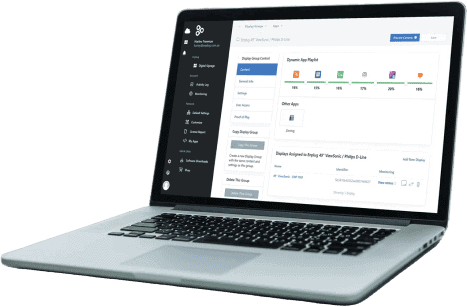
Enplug's display management platform is designed with exactly this kind of operational flexibility in mind – and its app library gives businesses access to a wide range of content integrations out of the box.
4. Ask Hard Questions About Reliability and Uptime
Your digital signage needs to work each and every day, without fail. It needs to be consistent, reliable and able to operate without constant IT attention. Whether you’re promoting the latest sale or sharing highlights from your tourism company, your screens should work seamlessly in the background while you get on with business.
When evaluating providers, dig into the reliability question directly:
- What is the platform's guaranteed uptime?
- What happens to your screens if the internet connection drops? Will they go blank, or continue playing cached content?
- How are software updates handled, and do they cause any downtime?
- What monitoring tools are available to confirm all screens are online and playing the correct content?
A good digital signage vendor in Australia will have clear, honest answers to all of these questions. Be wary of providers who are vague on uptime commitments or who cannot explain how their system handles connectivity loss.
5. Scrutinise Security Credentials
Digital signage systems are connected to your network. That means security is not optional – it is essential. This is particularly true for businesses in healthcare, finance, government and education, where data protection obligations are significant.
When assessing security, look for recognised compliance certifications. SOC 2 Type 2, for example, is an internationally respected standard that verifies a provider's controls around data security, availability, and confidentiality.
Enplug holds this certification – details are available on the Enplug security page – giving Australian businesses confidence that their content and network data are managed to enterprise-grade standards.
It’s also important to confirm whether the platform supports role-based access controls, allowing you to determine which team members can make changes to which screens.
6. Assess Hardware Compatibility and What Is Included
Software only or software and screens?
Some digital signage providers are software-only, meaning you source your own displays and media players. Others offer bundled hardware and software packages.
Both models have their pros and cons, but it is important to understand what you are looking for, and what you are committing to, before you buy.
If you’re looking for included hardware, then where are some key questions to ask:
- Is the media player device proprietary, or does the software run on standard hardware?
- Is the hardware covered under warranty, and for how long?
- Can the software run on displays you already own?
- Are installation services available in your location across Australia?
Affordable digital signage solutions in Australia do not always mean cheap hardware – they mean hardware that is appropriately specified for your use case and supported properly over its lifecycle.
7. Evaluate Ongoing Support and Local Presence
What happens when something goes wrong?
For many businesses, this is the most undervalued criterion in the vendor selection process – until they need support and cannot get it.
When assessing digital signage support in Australia, ask:
- Is support available during Australian business hours, or are you dealing with an overseas helpdesk in a different time zone?
- What are the support channels: phone, email, live chat?
- Is onboarding assistance included, or charged separately?
- Are software training resources available for your team?
A provider with genuine local presence and responsive Australian support is worth paying a small premium for. The alternative – being stuck with a technical problem and waiting days for a response from an offshore team – is a false economy.
8. Compare Pricing Models Transparently
One of the biggest factors for many businesses when it comes to investing in digital signage is the costs.
Digital signage pricing in Australia varies considerably between providers. Some charge per screen per month, others offer site licences, and some bundle hardware and software into a single package price.
When comparing costs, look beyond the headline number. Consider:
- What is included in the subscription: software only, or support as well?
- Are there setup or installation fees?
- What happens to pricing as you add more screens?
- Is there a contract lock-in period, and what are the exit terms?
The goal is to find a provider where the pricing model scales fairly with your business, rewarding growth rather than penalising it. By planning for the long term, you ensure your digital signage can scale with your business, and you get the best return on investment.
Why Australian Businesses Choose Enplug
Enplug is a leading digital signage platform trusted by businesses across retail, hospitality, healthcare, real estate, corporate, and education sectors in Australia and globally.
With an intuitive cloud-based CMS, a rich app ecosystem, enterprise-grade security, scalable multi-screen management, and dedicated Australian support, Enplug is built to meet the needs of businesses at every stage – from a single display in a boutique store to a national network of hundreds of screens.
Whether you are deploying digital signage for the first time or looking to switch from a provider that is no longer meeting your needs, Enplug makes the process straightforward from day one.
Contact Enplug today to discuss your requirements and get a tailored recommendation for your business.
on September 23, 2026 6:56 am